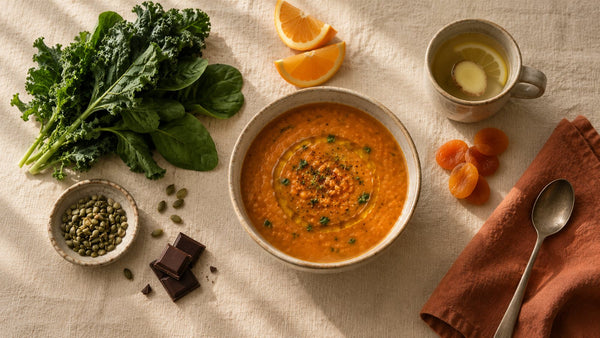
In your follicular phase, the stretch after your period when your body starts building towards ovulation, there's no special diet you need to follow. The most useful thing you can do is simple: build meals around protein, fibre-rich plants and iron-rich foods paired with a little vitamin C, which helps you top up the iron you lost during your period. Below: a quick list with honest evidence labels, easy meals, and straight answers on when this phase starts, energy, hunger and seed cycling.
In this guide: When is the follicular phase? · The quick list · Easy meal ideas · Not feeling energetic? · Hunger and bloating · Seed cycling
When is the follicular phase?
Two definitions are in use, which is why this confuses so many people.
- Medically, it begins with day one of bleeding and ends when you ovulate. Along the way, a hormone called FSH prompts follicles in your ovaries to grow, and oestrogen rises as one follicle takes the lead.
- In cycle syncing, including our own guides, the period days get their own "menstrual phase" (roughly days 1–5), and "follicular" means the days after it, roughly days 6–13.
Same stretch of your cycle, divided differently. This article covers the days after your period. If you're still bleeding, our guide to menstrual phase foods is the one you want.
One more honest note: "days 6–13" is only a rough guide. The follicular phase varies more than any other part of the cycle. In a large study of over 600,000 cycles tracked in an app, it averaged about 17 days but ranged from around 10 to 30, and it was the main reason some people's cycles are longer than others. Your own rhythm is the one that counts.
Follicular phase foods: the quick list
Many follicular food lists promise foods that "boost oestrogen" or "balance hormones". There's no good evidence any food does that, so here's solid everyday nutrition instead. Good means well-established nutrition basics; nice to have means nutritious, but the popular claims go beyond the evidence.
| Food | Why it's useful now | Evidence |
|---|---|---|
| Lentils, beans and chickpeas | Iron, protein and fibre in one cheap, filling food | Good |
| Red meat, if you eat it | Iron in a form your body absorbs easily | Good |
| Eggs, fish, chicken or tofu | Protein to build simple meals around | Good |
| Spinach, kale and broccoli | Iron and fibre from dark green vegetables | Good |
| Red peppers, citrus and berries | Vitamin C helps your body absorb iron from plant foods | Good |
| Oats, brown rice and wholegrain bread | Fibre and steady, satisfying meals | Good |
| Pumpkin seeds and ground flaxseed | Nutritious toppers; claims that they balance hormones aren't proven | Nice to have |
Why iron again? Your period has just ended, and people who menstruate need more iron than people who don't. The NHS puts the daily amount at 14.8mg for women aged 19 to 49. The trick most lists skip is absorption: eat plant iron with a source of vitamin C, and keep tea and coffee for between meals, because the tannins in them make iron harder to absorb. The British Dietetic Association's iron food fact sheet covers both habits.
Easy follicular phase meal ideas
Easy meals are the most-asked question about this phase, so here are a few:
- Breakfast: porridge or overnight oats with berries and a spoonful of pumpkin seeds, or eggs on wholegrain toast with cherry tomatoes.
- Lunch: our go-to bowl (below), or a big salad with chickpeas, peppers and a lemon dressing.
- Dinner: salmon or tofu stir-fried with broccoli and red pepper, over brown rice.
- Snack: hummus with red pepper sticks, or yoghurt with berries.
Our go-to: the lentil, spinach and red pepper bowl
If we had to pick one meal for the days after your period, it's this one, because every part of it does a job:
- Lentils bring the iron. A cup of cooked lentils has roughly 6–7mg, close to half the NHS daily amount for women aged 19 to 49.
- Red pepper brings the vitamin C, which helps your body absorb that plant iron. Raw red pepper is one of the richest everyday sources, so add it as fresh strips or only lightly roasted.
- Spinach adds more iron and fibre, wilted in at the end.
- A squeeze of lemon on top adds a little extra vitamin C and brightens the whole bowl.
Spoon warm lentils over a handful of spinach so it wilts, add the pepper, a drizzle of olive oil and the lemon, and top with pumpkin seeds if you have them. Make a big pot of lentils at the start of the week and it takes five minutes. Have your tea or coffee between meals rather than with it.
Meal-prep tip: cook one batch of lentils and one of grains on a Sunday. With those in the fridge, most of the meals above come together in minutes. If you'd like every day planned for you, our 28-day cycle-synced recipe book has full meal plans for each phase, with ingredients and methods.
Vegetarian and vegan follicular phase foods
Plant-based eating suits this phase well. The habit to keep is pairing plant iron with vitamin C at the same meal:
- Lentils or chickpeas with peppers, tomatoes or a squeeze of lemon
- Tofu stir-fry with broccoli and red pepper
- Porridge or fortified cereal with berries or a glass of orange juice
- Hummus with pepper sticks
Not feeling energetic? That's normal
Cycle-syncing content often calls this your "high-energy" phase. If you don't feel it, the research is on your side.
A large 2020 review of 78 studies on exercise performance across the menstrual cycle found that, on average, the differences between phases were trivial. If anything, performance might be very slightly lower in the early follicular days, which are your period days. The authors concluded that general rules can't be made and that a personalised approach makes more sense. A 2023 review of the wider research reached a similar view: the cycle's effect on most aspects of physiology is small or non-existent.
Some people feel brighter after their period and some don't; both are normal. Sleep, regular meals and enough iron matter more. If you're tired all the time or short of breath, talk to a doctor rather than putting it down to your cycle.
Hunger, appetite and bloating across your cycle
Some people feel less hungry after their period, and there's research behind that. A 2025 review that pooled studies on food intake found that, on average, people eat more in the luteal phase (the days before a period) than in the follicular phase. Another review noted intake is often lowest around ovulation. The studies vary a lot, though, and most relied on people recording their own food, so treat it as a loose pattern. If you're hungry, eat. Your body isn't reading the chart.
Bloating follows a pattern too. In a year-long study, women rated how much fluid they were retaining every day: it peaked on the first day of their period and was lowest in the middle of the follicular phase. That may be why many people feel lighter in the days after their period. It's about water, not fat, and it's a normal part of a cycle.
The best way to learn your own pattern is to notice it. The wellness tracker in our cycle syncing food chart bundle has daily logs for energy, sleep, mood, physical comfort and symptoms, so after a couple of months you'll know how you actually feel in each phase, not how a chart says you should.
What about seed cycling?
Seed cycling means eating flax and pumpkin seeds in the first half of your cycle and sesame and sunflower seeds in the second, to "balance hormones".
A 2025 systematic review found some positive signals, but only from small studies of moderate quality, mostly in people with PCOS or PMS, and the authors called for larger trials. An older trial that found flaxseed lengthened the luteal phase gave flax every day of the cycle, which isn't the seed-cycling routine at all. So there's no good evidence that rotating seeds by phase balances hormones.
The seeds themselves are nutritious, though, so a spoonful on porridge or salad is a good habit. Just don't expect them to change your hormones.
Are there foods to avoid in the follicular phase?
Not really. We couldn't find any research showing that a particular food should be avoided in this phase specifically, and reviews of cycle-syncing diets find little evidence for phase-by-phase food rules in general. The everyday advice still applies: keep heavily processed foods and alcohol in moderation, and keep tea and coffee away from iron-rich meals. Beyond that, you don't need to cut anything out.
Frequently asked questions
Does the follicular phase start after your period?
Medically, no. It begins with day one of bleeding and ends when you ovulate. Cycle-syncing guides, including ours, give the period days their own "menstrual phase" and call the days after it, roughly days 6–13, the follicular phase. Both describe the same part of your cycle, just divided differently.
Does the follicular phase make you hungry?
Usually less than in the days before your period. Research suggests people tend to eat a little less in the follicular phase than in the luteal phase before their period, with intake often lowest around ovulation. Studies vary and everyone is different, so if you feel hungry, eat. Regular, filling meals with protein and fibre help.
How do you feel in the follicular vs luteal phase?
Some people feel lighter and brighter in the follicular phase and more tired, hungry or bloated in the luteal phase. Research shows big individual differences, though, and average effects on energy and performance are small. Tracking how you feel for a few cycles is the most reliable way to learn your own pattern.
When are you least bloated in your cycle?
For many people, in the middle of the follicular phase. In a year-long study, self-rated fluid retention was lowest in the mid-follicular days and highest on the first day of the period. Those shifts come from water, and they're a normal part of how a cycle works.
What seeds should you eat in your follicular phase?
Seed cycling suggests flax and pumpkin seeds, but there's no good evidence that this balances hormones. Both are nutritious, so they're a fine addition to porridge, salads or yoghurt. Enjoy them as good food, and don't worry about getting the timing exactly right.
The gentle takeaway
The days after your period don't call for a special diet. Build easy meals around protein, fibre and iron-rich foods with a little vitamin C, keep your tea for between meals, and listen to your own energy and appetite rather than a chart. If you only try one thing, make it the lentil, spinach and red pepper bowl.
For the full picture, read our guide to what to eat in each phase of your cycle. Want it all on one page? Sign up for the free Cycle Phase Cheat Sheet at the bottom of this page.
Sources
- Cleveland Clinic. Follicular Phase (updated June 2026); Menstrual Cycle (Normal Menstruation). my.clevelandclinic.org.
- Bull JR et al. (2019). Real-world menstrual cycle characteristics of more than 600,000 menstrual cycles. npj Digital Medicine, 2, 83. PMID 31482137.
- NHS. Iron; Iron deficiency anaemia. nhs.uk.
- British Dietetic Association. Iron: food fact sheet. bda.uk.com.
- Hallberg L, Brune M, Rossander L (1989). The role of vitamin C in iron absorption. International Journal for Vitamin and Nutrition Research Supplement, 30, 103–108. PMID 2507689.
- Disler PB et al. (1975). The effect of tea on iron absorption. Gut, 16(3), 193–200. PMID 1168162.
- U.S. Department of Agriculture. FoodData Central: lentils, cooked (3.3mg iron per 100g); sweet red peppers, raw (128mg vitamin C per 100g).
- McNulty KL et al. (2020). The effects of menstrual cycle phase on exercise performance in eumenorrheic women: a systematic review and meta-analysis. Sports Medicine, 50(10), 1813–1827. PMID 32661839.
- D'Souza AC et al. (2023). Menstrual cycle hormones and oral contraceptives: a multimethod systems physiology-based review of their impact on key aspects of female physiology. Journal of Applied Physiology, 135(6), 1284–1299. PMID 37823207.
- Tucker JAL et al. (2025). The effect of the menstrual cycle on energy intake: a systematic review and meta-analysis. Nutrition Reviews, 83(3), e866–e876. PMID 39008822.
- Rogan MM, Black KE (2023). Dietary energy intake across the menstrual cycle: a narrative review. Nutrition Reviews, 81(7), 869–886. PMID 36367830.
- White CP et al. (2011). Fluid retention over the menstrual cycle: 1-year data from the prospective ovulation cohort. Obstetrics and Gynecology International, 2011, 138451. PMID 21845193.
- Nagarajan DR et al. (2025). Efficacy of seed cycling as an integrative therapy for premenstrual syndrome and polycystic ovary syndrome in reproductive-aged women: a systematic review. Cureus, 17(8), e90997. PMID 41018334.
- Phipps WR et al. (1993). Effect of flax seed ingestion on the menstrual cycle. Journal of Clinical Endocrinology & Metabolism, 77(5), 1215–1219. PMID 8077314.
This article is for educational purposes and isn't medical advice. Speak to a healthcare professional about your individual needs.
Last reviewed: 29 October 2026 · The itsjustmy Wellness Team